
Why is it that my top 3 most popular posts on this blog are the ones that are the most controversial? Are you guys trying to tell me that you like my biting sarcasm and wit and when I get sassy and borderline inappropriate? Or maybe is it because you like reading something painfully honest, wait…..EVERYBODY HALT! OMG a blog being CANDID AND NEGATIVE?!?! Shocking.
ALL of us bloggers (with the exception of Will Peach) are guilty of creating a fantasy travel bubble filled with rainbows and unicorns, where our lives are literally picture perfect; where we journey around the world without a care in the world and if anything does go wrong, it ends up as a cutesy-comical-learned-my-lesson anecdote on our blog, if mentioned at all. Hey, I’m equally guilty of this. I want my blog to be a happy place, where I share the best experiences I’ve had traveling and show others how to achieve the same.
But there are three things I can’t tolerate in life: unfairness, bullshit, and mayonnaise (nothing ruins a burger or sandwich like that nasty white stuff in a jar). And if something has been nagging me for years, I’ve gotta stand up and say something! Maybe I am just on a high from the success of a recent article I wrote about how Kaplan Killed the Hopes and Dreams of 42 Bloggers. Maybe I’m just bitter and hormonal from my breakup with Spain. Either way I am about to break it down for you.

I have been living in Spain for the past two years with the English teaching assistant program through the Spanish Ministry of Education (auxiliares de conversación), and you know what? IT EFFING SUCKED! Not the living in Spain bit, that was awesome, rather the program itself.
I literally have hundreds of emails, messages, tweets and comments asking me questions about working in Spain as an auxiliar, whether about visas, apartments, taxes, money or even if they should apply or not, I hear it all. And I almost always give the same answer, “yeah this program is great. I love living in Spain. Bulls. Flamenco. Paella. Sangria. Yada yada yada.” But here it is, my REAL, uncensored, unedited thoughts about coming to Spain with the auxiliar program.
AND I am going to break the cardinal blogging rule here and put HATE in the title of this post. I’ll put in all-caps for good measure. Maybe I’ll lose a few readers. I’ll probably get enough hate mail to make me want to off myself by tomorrow (seriously, you anon readers can be wicked harsh!) but I feel honor bound to share how I really feel about this program on my blog, especially since such a large part of my audience are past-present-future auxiliars. Someone needs to say it. Might as well be me. And according to my stats, this is the kind of stuff you like to read. Don’t shoot the messenger!
Just remember guys, I’m not a hater, really I’m not! If you’ve ever had the pleasure of meeting me, I am bubbly, blonde and happy. Just indulge me this one time on my tirade.

Here are My Top 5 Reasons Why I HATE the Auxiliar Program in Spain (you know, top 5, because I can think of more than 5)
1. It’s a disorganized clusterfuck
To put it mildly. In fact all the things I hate about this program are so disorganized in my head from all my problems dealing with the disorganization with the Ministry, I don’t even know where to begin. I’ll elaborate in bullet points:
- The application process. Who actually understands it? 3 years down the road and I don’t! Don’t even get me started about renewing. What if you’re switching regions? What if you are renewing for a third year and switching regions? Where do we send the documents? Wouldn’t it be nice if we had all of these answers available to us on the application page? The only information we get from the Ministry are monthly newsletters in comic sans font sent every three months to half of the mailing list that don’t say anything valuable and look like they were designed by my 11 year old sister. Why are all the regions in Spain listed on the application when the program has been cut from several of them? Oh that FBI report you had to get for your application? Yeah, you have to get a whole new one for your visa because they expire and we didn’t tell you! Do we have orientation? Who gets to go? Where is it? When is it? Also, everyone is assigned a number upon submitting an application, first time renewals get placed first, then first year applications and third year renewals. Except the Ministry doesn’t always follow those rules and places people willy nilly. I can go on and on
- Hey remember that one time thousands of people didn’t get paid for 3 months? Oh wait, that’s every year!
- It is not unusual for ministry officials to give out conflicting information about everything, if you can get a hold of them at all. In fact, many of the schools aren’t informed about what your role as an assistant is, leaving you open to all mannars of interpretation. You could spend your year sitting at a desk in the back playing solitaire or you could be left alone in the room with 25 screaming 3 year olds. Hopefully you end up somewhere in the middle.
- Pretty much the people who run this program don’t know what they are doing, so don’t expect clear answers. Inconsistent information is the name of the game with the auxiliar program in Spain. Get used to it.
- Have you read my post about how I spent over 4 months being jerked around by the guys who run this program in Madrid and why I ultimately left Spain?
The upside? You get a visa to live in Spain, which is nigh on impossible to get any other way as an American.
2. A total hit or miss
Your experience as an auxiliar can be a total hit-or-miss and you might not have any control over it. From my own observations, it seems applicant’s names, regional preferences, city and school type are all thrown in a giant jar, swirled around and plucked right back out. i.e., it makes no sense.
You could end up working at an amazing concertada (semi-private) modern school right in the city center with amazing goal-oriented teachers and well-behaved students. Or you might end up in a village of 5,000 people, in rural back country Spain where your students don’t know the difference between England and America, the English teacher doesn’t speak any English and you have to commute an hour to work every day. The range of possible situations you could end up with is HUGE and they will either positively or negatively impact your year, depending on how flexible and open minded you are.
For example, this year I had an amazing schedule. I worked Monday through Thursday, 9am to noon at 2 schools in the center of Logroño. I had to take a 10 minute bus ride to get to work every day. Totally feasible. I had other friends who were placed at schools in villages over an hour away, that they not only had to commute to, they had to pay the teachers to let them ride with them to and from work, over 100 euros extra a month, and they were given schedules with huge breaks in them so they were stuck in their villages for hours without classes.

I think my year would have gone a bit differently under those circumstances. My schools were generally flexible with my schedule if I wanted to travel, I could make up hours. Other schools don’t let the auxiliars miss any days or hours and some even give them schedules where you would have to work Mon, Tue, Wed, Fri. Complete hit or miss, you have no control over.
I’ve worked with 2 teachers who really wanted to take advantage of having a native speaker in the classroom to help the kids. They understood what a unique opportunity it was to have an American there helping the kids learn English. The other 10 teachers I’ve worked with ranged from they really didn’t give a damn to they wanted to use me so they could get out of doing their job.
Be warned, some teachers will take advantage of you in the classroom. Know your role. We are assistants, not the teachers. We provide supporting material and help, but we don’t plan the lessons. We’re not supposed to be alone with students. I’ve had friends who were forced to do everything, spend hours at home planning lessons and even forced to work more hours or face having a “horrible” schedule or be complained about. I had huge problems with this my first year and getting taken advantage of in the schools. Don’t let it happen to you.
You could get paid on time every month since you start. You could go months without being paid. Unless you are a trust fund baby, I expect that would make a BIG difference in how your year goes.
The upside? You could have the best year of your life! I am a true believer that experiences are what you make of them, so even if things don’t go exactly how you’d for them to, try to focus on the positive! You get to live in Spain!

Me and the lovely Liz of Liz en España and now A Midwestern Life
3. The funcionarios who work for the Ministry
Is it just me or is everyone who works for this program (from the Spanish consulates in the US to the regional coordinators to the directors in Madrid) a certified straight up d-bag?
Of all the people I’ve dealt with over the years with this program, I’ve known one, ONE nice, helpful person! And they fired her after a year!
In case you didn’t know, funcionarios are government employees in Spain, and they basically make a lot of money and can never be fired, simply put. Here is a video that explains them to a T. Ok, sweeping generalization but that’s how I feel about these guys, along with many Spaniards.
Not only do they generally have no idea what’s going on, they are also rude and unhelpful in general. I can talk to them for hours on the phone or in person and leave the conversation not knowing anything more than I did when I started! And on top of that they make you feel bad about it! I have even had them intentionally hang up on me when I was demanding to know when we would get paid in La Rioja last year, sparking my most popular post. I would go into a meeting with the program director’s to ask when we would get paid, and I would leave feeling like everything was my fault for not being ok with not being paid! WTF?!
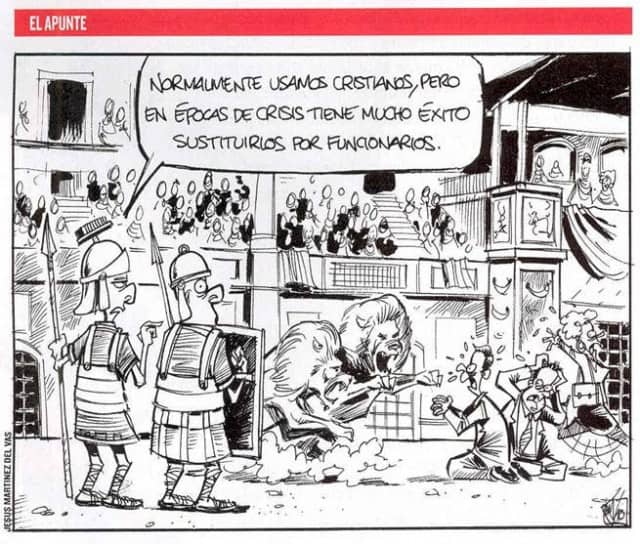
“Normally we use Christians but in times of crisis, substituting funcionarios has been very successful.” Source
They are probably so unhelpful because they aren’t informed themselves. But last time I checked in the real world in a professional job, when you don’t know something, you say, “you know what? I am not sure. Let me check and get back to you” instead of “this is so-and-so’s responsibility, go ask them” that is, if you can get a hold of anyone at all.
I have scheduled meetings with coordinators and they have shown up an hour late, most of the time they don’t answer my emails or phone calls. In fact, the only time they call me back is when I threaten to go to the US embassy or I call them directly out on not doing their job. Then I get a phone call from some official all fussy and upset by my insinuations.
For example, my first year in Córdoba, we weren’t even provided with the contact information for the regional or city coordinator. If we had a problem, we didn’t have anyone to talk to except with our schools.
If I had a euro for every time I got a runaround answer from a ministry official in Spain, I would be as rich as Iker Casillas.
The upside? You learn to take things into your own hands, I guess. Honestly, I can’t really think of an upside to this unless you miraculously end up working with amazing coordinators and directors. We’ll go back to the you get to live in Spain thing. Big upside.

4. The Visa Nightmare
I call it a nightmare because every time I had to think about my experiences with the visa and NIE, I want to die. The entire paperwork process from applying for the visa, applying for a NIE, renewing your NIE, and the details of living in Spain with a student NIE could not be more stressful and complicated!
I understand that this process is not really within control of the Ministry of Education, but at the same time, it is a government sponsored program, and one of the guarantees is a NIE. I think the Ministry needs to do two things:
- Provide a better guideline for auxiliars about how and when to apply for the visa and the NIE and how to renew it. Really, it cannot be that hard to put something together. In fact, it would be great if that was what they talked about at orientation instead of 2 hours of how the Spanish education system works in rapid-fire Spanish that I am sure half of the first years do not understand. Shouldn’t the English bilingual coordinators speak English?
- Coordinate with the local extranjerías about the auxiliar program. They need to understand this program, what dates should be given on the NIE’s, renewals, ect. It is not that hard to go meet with them and explain so that everyone is on the same page. This would avoid so many nightmares
This all goes back to the disorganization and hit or miss. For example, some people are given papers that expire exactly one year after they submit the paperwork, so September or October of the following year. Some people are given cards that expire exactly on May 31. The rest, somewhere in the middle. It makes absolutely no sense. You could end up completely screwed like with what happened to me. If I was given the correct papers with the correct dates, I could still be in Spain right now.
It gets even more complicated when you try to renew your papers, and if you try to switch regions. Some regions will let you renew no problem. Others make you go back to America and get a whole new visa. Hit or miss. Some regions even let you submit the paperwork in the fall to renew and then told you a month later you needed to buy a last minute flight to America and get a whole other visa. It’s actually ridiculous. Try buying a $1000 flight home when you haven’t even been paid!
Sometimes it takes so long for the offices to process your paperwork you can go the whole year without getting a NIE! Or they give you appointments after your visa has expired.
The upside? You (hopefully) get papers to live in Spain! It’s almost impossible to get a visa otherwise as an American. That is if you can survive the deathly obstacles thrown at you

5. Kept blind and in the dark
I think singlehandledly the thing I hated most about the program besides the disorganization is the fact that the Ministry did a terrible job of informing us of ANYTHING!
It’s one thing to be disorganized but at least tell us what’s going on. Here are the 3 main things the Ministry should keep in contact with the auxiliars about
- If there are going to be delays with payments, tell us! It’s not that hard. We shouldn’t have to complain and whine about it to the newspapers and American embassies into shaming the Ministry into paying us, or at least saying when we’ll be paid. Last year they weren’t planning to even tell us in La Rioja about the delays until dozens of us called and emailed and demanded to know what was going on.
- When the government cuts hundreds of auxiliar positions and even whole regions, it is their duty to tell us! You shouldn’t have to find out everything on facebook or through me. In fact, I think the government should be contracting me since I have been doing half of their work for them for YEARS!
- They should explain clearly what our job is, what it entails, our benefits, our rights, ect.
This lack of Ministry information directly leads to mass hysteria on the dozens of facebook groups and expat forums about this program. When I mentioned that to a director in Madrid he yelled (literally yelled) at me about how we shouldn’t listen to these things on Facebook. I kindly replied that it’s the only way we learn anything or know what’s going on, which led to awkward silence…
The upside? You learn to be patient or you just lose your marbles

The point of this post is not to whine and moan about the auxiliar program in Spain. It is to share an actual and honest opinion of a program that has been glamorized far too often. People have been asking me for years about what I really think about it, and I feel it’s high time for an honest answer. Negative hate and all.
Are you an auxiliar in Spain? What was your experience like with the program? Have or heard any horror stories? What did you hate the most about it?
Image 1 Source
About the author










This is the post I always wanted to write, but never did because I knew it would be controversial in the auxiliares de conversacion blogosphere. I have a lot of issues with the auxiliares program, including many schools claiming to be “bilingual” when in fact they aren’t. That’s a whole other kettle of fish I won’t go into, but it strikes a nerve in me for personal reasons.
I didn’t go through the Auxiliar program, I got a scholarship through a private company that places native English speakers in the Madrid area. I got paid on time, I worked 25 hours a week, and the pay was pretty good. I definitely made more money than Auxiliares since I was working more hours. However many of the bullet points you provided apply to the program I did too.
1. disorganized mess.
The visa/NIE process was no easier for the people doing it through my program. The coordinator of the program did email us updates when she got information from other auxiliares who would go to the police station for the NIE application/renewal process, but the information would change daily. I have to say, the coordinator did her best to email us up to date information, but it didn’t stop my American friends from running all over Madrid paying tasas, getting forms, and what not. I didn’t have to deal with this because I have French citizenship, I merely got a certificate that said I was an EU citizen and that had my NIE number listed (with misspelled information including my place of birth listed as Princeton, New Jersey, France). However, the disorganized mess is due to Spanish bureaucracy and wasn’t my program’s fault.
2. Hit or miss.
I actually ended up switching schools after 2 months because I tried to stand up for myself in the first school I was placed in. In our contracts (we had contracts that specifically stated our rights and obligations that we had to sign, I don’t know if the Auxiliar program has one) it explicitly stated we were not to be left alone in the classroom. My first school didn’t care and treated me as a teacher in which I was expected to grade tests, give homework, and prepare lessons. When my fellow auxiliar and I complained, we were sent packing and switched schools. The program we worked for couldn’t really do anything about it. If the school wasn’t happy with us, the only solution was to send us to another school.
At the following school, the teacher didn’t leave the classroom but here I got absolutely no direction at all from the staff. I was the “science” teacher and I had a book but I had no idea what do with it.
At this school, the staff had no clue how to use the auxiliares. They tried to get me to put on an English play with some of the 5th and 6th graders–never mind I had no theater experience, or knew the first thing about putting on a play! In the end, some of the music staff took over and helped me out and the kids got really into it. But before that happened, I was stumbling in the dark.
3. lack of communication between all parties: the schools, the coordinators of the program, and the auxiliares!
The lack of communication brought about so many misunderstandings and mishaps, I can’t even count!
In the end, I decided teaching English wasn’t for me and staying in Spain a third year wasn’t worth it (I originally came over in 2010 for a master’s and stayed a second year teaching English). I could have gotten another job because I have EU citizenship, but ultimately 3 reasons made me leave: 1) The only job available to native English speakers seemed to be teaching. 2) the looming economic crisis 3) I missed my family. 4) I wanted to do something I actually enjoyed doing.
Like you, I kept the negativity out of my blog. However behind the scenes, it was really bad. The Jefa de Estudios at my first school reduced me to tears when she met with me privately twice in her office. She told me I was doing a horrible job when the truth was the school was violating my contract. I was also blamed for one or two incidents that were beyond my control. I felt like such a failure and it took me awhile to realize I couldn’t take it personally and that I was in way over my head.
I love Spain and I may end up again there someday, but it won’t be through teaching.
Amelie! Im not sure you remember me but I was on the Malaga program with you at Dickinson and the same thing happened to me in terms of the Jefa de Estudios… they can be SOOOOOOO mean!
Hi Amelie,
I have just been accepted into the madrid auxiliary program. I am an EU citizen as well, and I was wondering what other documents we need to get the NIE number, like a medical certificate or a police check? Will I be able to rent a place without an NIE while I wait for the application process to be completed?
Thanks a bunch,
Annabelle
It’s only appropriate that I’m reading this sitting in my school, on a day when I’m spending 5 hours here, a total of 9 hours away from home when you add my commute, and I’m teaching a grand total of 1 hour today.
I had two wonderful years at two different primary schools, but my luck ran out this year (Apart from the incredible luck of managing a third year). I complained to the Junta about how unreceptive my coordinator was being with me, not communicating what the teachers want from me then telling me they’re not happy with me because I don’t bring full planned lessons with me. I’m pretty sure I got him in big trouble because my schedule is changing to much better hours (can’t do anything about the commute though). I’ll have to deal with a boss who hates me the rest of the year, but I stopped him taking advantage of me.
As many have said, the moral of the story is it’s hit or miss.
Julia, I did CIEE my first year. Feel free to ask me any questions, or read what I wrote a year ago about the two programs. http://teachlearnrun.blogspot.com.es/2011/11/want-my-life.html
Hey Liz,
Thanks so much for this post. I am applying to the Auxiliares program for 2013-14 and am so so glad I saw this. Definitely something that everyone should read before applying! Although the cons are pretty overwhelming, I appreciated the “but’s” at the end of each section. For me, living in Spain and adventuring is worth the complication, but I will definitely be heading in with lots of savings, an open mind, and PATIENCE 🙂
After your experience with the program, do you think the CIEE fee is worth it to have a sort of middle man between you and the government? Have you heard much about that program?
Thanks again 🙂
Julia
I’m not Liz, but a lot of my friends in CIEE (in Granada) had just as many issues getting paid. Two of my friends didn’t get paid until January. CIEE didn’t help them out at all.
this was last year, by the way, just to be clear 🙂
Ah, really? Good to know, especially since Granada is where I want to be! Thanks for letting me know 🙂
Thanks Shannon, I had no idea about CIEE. I was always hesitant because it is A LOT of money to pay from what sounds like not that much guidance.
I know friends placed in Granada on the regular program. I think it’s key to apply early and then as soon as you are accepted, send off an email or 10 to the auxiliar coordinator in andalucia and ask 🙂 good luck!
Liz, I cannot believe there are already 107 comments on this controversial entry! You can really tell that it has struck a nerve; I’m glad you wrote it to fill a niche and give a sounding board to these issues.
First of all, I think the biggest thing to highlight is that your placement is hit or miss. I realize this has been stated and restated a million times among the comments, but it bears repeating. The variations between my school and my friend’s schools were always surprising—from being involved in teaching to getting paid on time, the experience depends largely on your school.
I had a terrific school where the teachers cared about me and were concerned for a foreigner living far from home. Co-workers were enthusiastic about exchanging English-Spanish expressions, made sure I knew about school events, and saw to it that I was paid on time—often juggling the accounts when my money hadn’t been sent by the government. The problem was, no one really knew what I was supposed to do in the classroom. I was the first auxiliar my school had ever had, and they didn’t understand what my duties were. I arrived expecting them to guide me, and this just wasn’t the case. You can imagine how this resulted in a few awkward and frustrating first months.
Someone commented previously that, “if your teacher is putting you in the back of the room, then you need to stand up for yourself and ask what she/he would like you to do that day, or offer suggestions. If you are being asked to do all the lesson plans ask her/him to help you or what they think would be a good lesson. Force them to be a part of it or for yourself to be a part of it.” The feasibility of this advice is laughable. That first year, I was with a teacher who refused to let me be a part of the lesson, often refusing me entrance at the classroom door. On the other end of the spectrum I had a teacher who expected me to do everything with no guidance whatsoever. Both situations are impossible to fix if the co-teacher has no desire to change. In the first case, the situation was only improved once my coordinator decided my time was better spent with another co-teacher. The second was never remedied.
Finally—paperwork problems / being informed. Renewing my second year was definitely a nightmare, and here’s why: I had always been interested in renewing, and was closely following the instructions I had been given by the head office in Madrid. I finished the Profex paperwork in early 2011, only to be sent an urgent email in March saying that there had been a change—I not only need to submit these docs electronically, I now needed to also send a hard copy to my corresponding Spanish consulate in the US. Oh, and by the way, the paperwork had to be received by the end of March—a mere week away!
I flew into a frenzy getting all of my documents together, and looked up a way to send documents via 2-day express shipping. I spent over 50 Euros shipping the documents to the states, only to have the consulate send them RIGHT BACK TO ME IN MADRID. Worried and angry, I called my contact at the Ministry of Education, who told me that there had been a miscommunication and that I simply had to bring my documents into her office.
In the end I never found out what happened—all of my friends who were renewing had indeed had to send their documents to the states and had no problems with this. The idea I took away from this was that internally there was a lack of cohesion when it came to set processes. When considering to apply to or stay in the program, it is important to remember that requirements and conditions can change unexpectedly—will you be prepared?
LOVE you! I couldn’t have said it better myself.
I can’t believe the feedback from this post either. I never imagined it would be this big, which speaks volumes about the issue at hand! I’ve been getting a lot of messages and emails about it too, people are definitely touchy about this. But no matter how many comments I get, at the end of the day, this stuff needed to be said, clearly in one place. There is no excuse for what has been going on, this program has been around for years, they need to get their act together.
It’s curious because most people aren’t objecting to my 5 points, they’re objecting to the nitty gritty details from what your mentality should be like, to cultural differences to a lack of openmindedness. But they aren’t contradicting the fundamental base for this article, which is interesting.
I can’t believe what happened with your papers. It makes me sick to think how much money I wasted on similar incidents, hundreds of euros thrown away on trying to renew my NIE first year. I mean how can you compare that with someone who didn’t have to go through something similar? Who are they to pass judgement? It could have been worse, a friend of mine had to buy a last minute flight home to California in July to get whole new visa when she should have had too, thousands of dollars wasted over the incompetency of the Córdoba extranjeria and ministry in Andalucia.
Above all, you are right, it’s a hit or miss and you don’t have much control over it. You can control your attitude, your openmindedness and your tolerance, but at the end of the day, we all have our limits.
Thanks for commenting and for sifting through the whole post plus 100 comments!